
Anxiety is fear, agitation, or unease that arises when you feel that something threatening is looming. The threat might be specific, like an upcoming speech you must give, or it could be general, perhaps the ups and downs of everyday life. Whatever the cause, anxiety triggers physical, mental, and emotional reactions such as worry, nervousness, and unwarranted fear.
Everyone feels anxious at times, but people with addictions may feel it even more intensely, especially during early recovery. So much is riding on the success of recovery: jobs, family, income, self-esteem. Your anxiety level can skyrocket as you ask yourself “Can I do this? Will I ever recover completely?” And life’s everyday stressors not only start the anxiety cycle, but they can also help to keep it going perpetually.
Anxiety can greatly increase the risk of relapse for two reasons. First, anxious feelings are unpleasant, and it’s natural to want to do something to make them go away. For those who are accustomed to using drugs, alcohol, or acting out to blunt or mask their anxious feelings, the urge to use, drink or act out can become overwhelming. Second, addicts often misinterpret anxiety as craving and feel that they absolutely must use in order to make the craving (anxiety) go away. Unfortunately, many people in recovery are unaware that they are anxious or that they may even have a full-blown anxiety disorder.
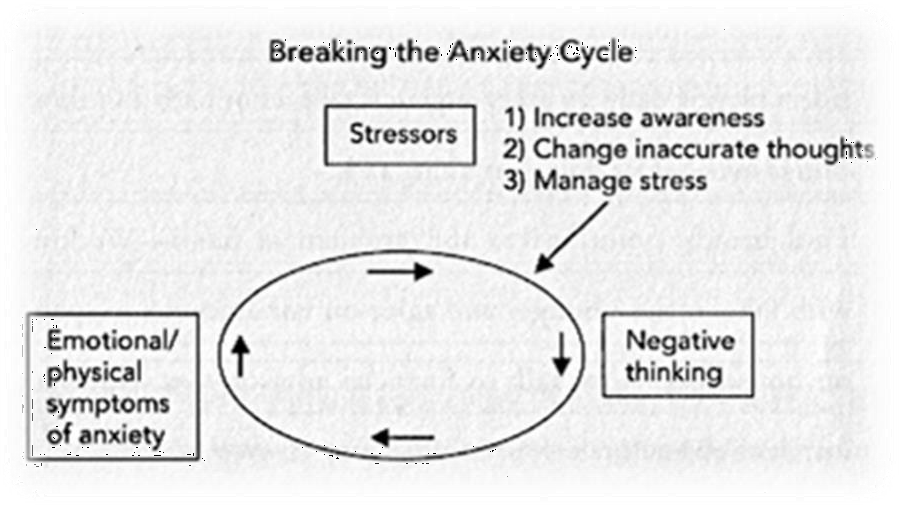
Anxiety occurs as part of a cycle that, unfortunately, can become vicious and self-perpetuating. It begins with stressors. A stressor is anything that elevates adrenaline and triggers the stress response. Loud noises, heavy traffic, arguments, money problems, illness, and divorce are just a few examples of stressors. Perhaps the stressor of the moment is a financial one. You don’t have enough money to pay the bills, and you’re worried about it. As the stressor becomes more intense, you fall into negative thinking patterns, telling yourself “I am a failure. I don’t make enough money because I have a lousy job because that’s all I’m worth.” These thoughts ratchet up the emotional and physical symptoms of anxiety. Your stomach begins to grind, your headaches, and your neck muscles tighten up. Now you’re not only worried but you also feel uncomfortable with negative self-defeating thoughts. Here are some ideas to help you break the anxiety cycle.
Increase Your Awareness
Before you can take steps to decrease your anxiety, you must figure out what’s causing it. Certain situations, people, places, times of day and thoughts can set the stage for anxiety that ranges from a little bit of nervousness to a full-blown panic attack.
- Keeping a journal is an excellent tool for discovering when and why your anxiety tends to arise. Each morning, afternoon, and evening, write down the time of day, the place, what you’re doing, and your current thoughts and feelings. You may also want to rate the intensity of your feelings from zero to 10, with 10 being the most intense. Make additional entries in the journal whenever you feel anxious. Overtime, the journal should reveal certain patterns that contribute to your anxiety.
- When analyzing an anxiety-producing situation, ask yourself if it is something that you can control. You have some control, for example, over the anxiety you may feel about your bills. You could eat out less often and buy fewer clothes. But in some situations, you have no control. For example, you may become anxious when a person you’re attracted to doesn’t return your interest. Then you must realize that you have no control over the other person and that you must let go. Trying to change the inevitable will simply increase your anxiety and get you nowhere.
Challenge and Change Your Negative Thinking
Your thoughts affect your feelings. Your feelings, in turn, influence your actions. This is especially true regarding anxiety. Your thoughts can cause your anxiety levels to skyrocket, inflaming the urge to drink, act out, or use. Or they can calm you down and help you stay on the sobriety track. Therefore, recognizing your pro-addiction thoughts and changing them to pro-recovery thoughts is an essential step in easing anxiety. Consider replacing unhealthy thoughts with the following health enhancing thoughts. Repeat often:
- using or acting compulsively to relieve my anxiety is dangerous.
- I can handle this feeling, and I can discover what is causing it.
- I don’t have to tolerate this feeling; I can control my thoughts that are causing it.
- Once I’ve managed my feelings of anxiety, I will feel stronger.
- I can and will learn how to control my thoughts, feelings, behaviours and beliefs so I won’t have to go through this prolonged anxiety anymore.
Manage Stress
There are many strategies and techniques for releasing and reducing stress and thereby lowering anxiety levels. Some of the most helpful include:
- Aerobic exercise (the kind that gets your heart pumping and increases your respiration) is an extremely effective anxiety-buster, relieving muscle tension, burning up stress hormones, and stimulating the release of endorphins, the bodies feel good hormones.
- It is physically impossible to be stressed and relaxed at the same time. That’s why practicing relaxation on a regular basis is the best way to lower your anxiety level and give your body and mind a “vacation” from stress. There are many good relaxation techniques including yoga, meditation, progressive muscle relaxation, deep breathing and visualization. There are some effective hands-on relaxation therapies such as massage, acupuncture, and reflexology. Find the one that works best for you.
- Many people are stressed because they have too many responsibilities and roles to fill but too little time. Try these tips.
- figure out the most efficient and least stressful way to do what must be done.
- Make a to-do list with the most important things at the top, the less important things beneath.
- Plan ahead to decide how to combine activities: look for shortcuts.
- Cross off any activities that you can skip.
- Do one thing at a time to increase efficiency and decrease the stress of multitasking.
- Develop realistic goals.
- Delegate tasks: you really don’t have to do it all yourself.
- Learn to say “no.” It’s alright to let people know what you can and can’t handle.
- An undernourished, exhausted, or under exercised body is a stressed body. Eat a healthful, balanced diet, get plenty of rest and sleep, and exercise for at least an hour every day.
- Friends, family, and recovery groups can help you get through the rough patches and validate your success. Use them.
 Don’t neglect having fun! Take time to do the things you enjoy with people you enjoy. Do things that feel good to you. Distract yourself when you’re stressed by having fun.